
Table of Contents
- Why Retro Style Casual Wear Works for Everyday Comfort
- How to Spot High Quality Cotton T-Shirts
- Styling Retro Graphic Tees for Weekends and Work
- Caring for Vintage-Inspired Cotton Clothing
- Retro Style Casual Wear Picks to Build a Capsule Wardrobe
- Size, Fit and Ethical Sourcing Questions Answered
- Frequently Asked Questions
Last Updated: September 12, 2026
Why Retro Style Casual Wear Works for Everyday Comfort
Retro style casual wear works because it solves a problem modern fast fashion created: clothes that feel stiff, look generic, and fall apart after a season. This guide from Steve's Finds explains how vintage-inspired pieces, from sun-faded tees to wide-leg jeans, deliver lived-in comfort without the thrift-store hunt. The retro aesthetic is having a genuine revival, and for good reason.

Here's the core argument: retro style isn't nostalgia for its own sake. It's a practical response to disposable clothing. Heritage-inspired cuts were designed to be worn, washed, and worn again for years.
That durability starts with the fabric itself.
Textile guidance from the Australian Competition and Consumer Commission on clothing care labelling confirms that clear care instructions are a consumer right, and quality garments tend to carry more detailed labelling.
How to Spot High Quality Cotton T-Shirts
High quality cotton t-shirts share three traits: a heavier fabric weight, reinforced stitching at stress points, and a fit that holds its shape after washing. Checking these before you buy separates a tee that lasts years from one that pills in weeks.
Most shoppers judge a t-shirt by how it looks on the hanger. That's the wrong test.
Fabric Weight, Stitching and Fit Checks
Fabric weight is measured in grams per square metre (GSM). A lightweight tee sits around 140-150 GSM, while a substantial everyday tee runs 180-220 GSM. Heavier cotton drapes better and resists the thin, see-through look that cheap tees develop.
- Fabric weight: Look for 180 GSM or higher for a tee that feels substantial
- Stitching: Check for double-stitched hems and side seams, not just the neckline
- Fit: A true-to-size cut should drape comfortably without pulling across the chest
- Neckline: Ribbed collars resist stretching better than plain jersey
- Colour: Sun-faded tones should look intentional, not washed out
A common mistake is buying on price alone. A slightly heavier tee costs more upfront but outlasts three cheap ones.
Steve's Finds applies this thinking to its Rockstar Streetwear White Cotton Tee, a 100% cotton piece cut true to size as a clean wardrobe staple.

Styling Retro Graphic Tees for Weekends and Work
Styling retro graphic tees comes down to balance: let the print lead, and keep everything else simple. A graphic tee anchors a casual weekend look, and with the right layers it works for smart-casual settings too.
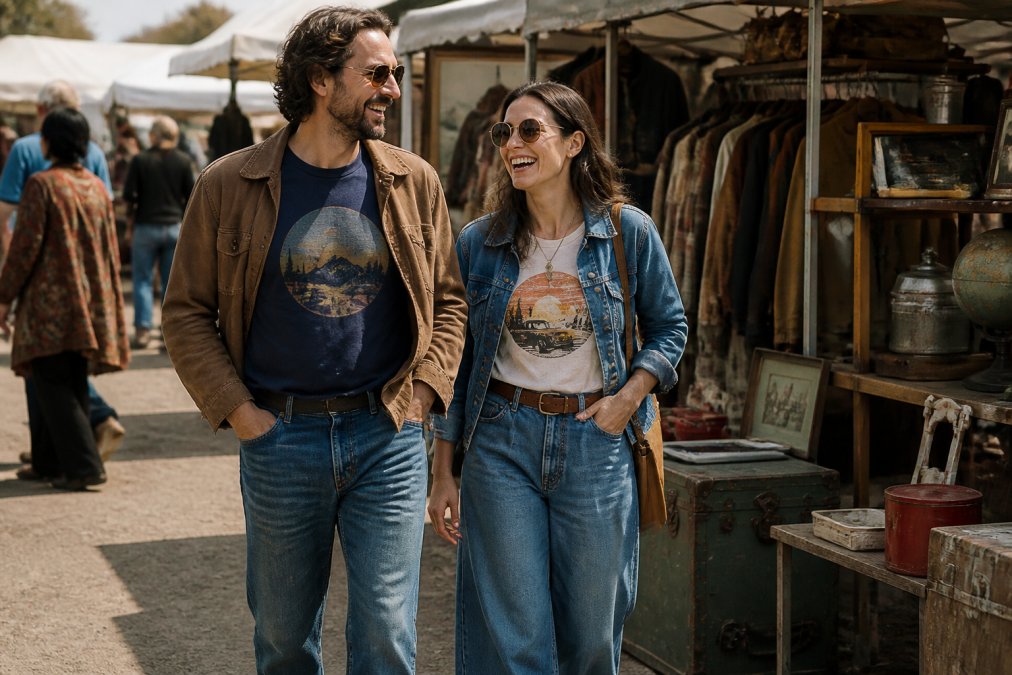
Smart-Casual Ways to Wear Retro Prints
The trick is treating the tee as a foundation, not the whole outfit.
- Weekend: Graphic tee, wide-leg jeans, canvas sneakers
- Smart-casual: Graphic tee under an unbuttoned overshirt, chinos, clean boots
- Layered: Tee beneath a bomber or denim jacket for cooler evenings
- Work-friendly: Keep graphics small and tonal, pair with tailored trousers
What most guides miss is that a retro print in a muted, sun-faded palette reads far more professional than a loud one. Colour choice does the heavy lifting.
For a bolder take, the Y2K Grey Baggy Wide-Leg Jeans pair relaxed drape with a vintage hip-hop edge, ideal for streetwear-leaning outfits.
Caring for Vintage-Inspired Cotton Clothing
Caring for vintage-inspired cotton clothing means washing cold, drying flat or low, and turning prints inside out. These three habits prevent the fading and print cracking that ruin retro pieces fastest.
Cotton is durable, but heat is its enemy. Hot water and a hot dryer shrink fibres and dull colour.
- Wash at 30°C or colder to protect dyes and prints
- Turn graphic garments inside out before washing
- Skip the dryer where possible; line-dry in shade
- Use a gentle cycle for anything with a printed design
- Store folded rather than hung to avoid shoulder stretch
The Australian Government's Textiles and Clothing stewardship guidance highlights how extending a garment's life reduces textile waste, and proper care is the simplest way to do it.
Retro Style Casual Wear Picks to Build a Capsule Wardrobe
Most retro capsule guides hand you a shopping list. That is the easy part. The hard part is understanding why certain pieces work together, so you can build a wardrobe that survives trend cycles rather than a season.
A retro capsule rests on three structural rules:
- One silhouette anchor. Pick a single dominant shape, wide-leg, straight, or fit-and-flare, and let the rest of the wardrobe serve it. Mixing three competing silhouettes is what makes retro looks read as costume rather than clothing.
- Two base neutrals, one accent. Faded grey, ecru, washed black, or sun-faded tan form the base. The accent is where personality lives, a rust, mustard, or dusty teal that echoes across at least three pieces.
- Texture over print. Retro reads through fabric hand: slub cotton, brushed flannel, corduroy, ring-spun jersey. Prints are optional; texture is not.
Here is how that plays out across a practical starter set:
| Piece | Role in the capsule | What to check before buying |
|---|---|---|
| Quality cotton tee | Base layer, worn 3-4 days a week | 180 GSM or higher, ribbed collar, double-stitched hem |
| Wide-leg or baggy jeans | Silhouette anchor | Rise sits at natural waist, inseam clears the shoe by 1-2 cm |
| Printed long-sleeve shirt | Layering and accent | Print is tonal, not high-contrast, so it layers under jackets |
| Relaxed shorts | Warm-weather rotation | Shorts with a suitable inseam for retro proportion without looking dated |
| Neutral overshirt or bomber | Finishing layer | Shoulder seam sits on the shoulder, not past it |
The Fit Logic Behind Each Piece
The reason a retro capsule holds together is proportion, not nostalgia. Wide-leg jeans need a closer-fitting top to avoid a shapeless column. A boxy tee needs a slimmer bottom. A printed shirt works best open over a plain base so the print reads as a layer, not the whole outfit.
A common pattern among people who get retro styling right is that they treat every piece as either a volume piece or a line piece, never both. Volume on volume looks accidental. Line on line looks stiff. One of each is the balance point.
Where to Start If You Are Rebuilding
If you are replacing a fast-fashion wardrobe, start with the base layer and the silhouette anchor. Those two pieces do the most work and are the hardest to fake with cheap alternatives. Add the accent layer last, once you know which colour you actually reach for.
Size, Fit and Ethical Sourcing Questions Answered
Two questions decide whether a retro purchase works: will it fit, and was it made responsibly. Most retro guides wave at both. Here is the practical version.
Measuring for Vintage-Inspired Cuts
Retro silhouettes were drafted for different body proportions than modern fast fashion, so your usual size is not a reliable starting point. Measure three things before you buy:
- Chest or bust: measure around the fullest point, keeping the tape level. Compare against the garment's flat-lay measurement doubled, not the size label.
- Natural waist: the narrowest point above the navel, not where modern low-rise jeans sit. Retro cuts, especially fit-and-flare and high-waisted styles, are drafted to this line.
- Hip: measure around the fullest point of the seat. Wide-leg and A-line cuts need 2-4 cm of ease here to drape correctly rather than pull.
A common pattern is that shoppers sized for modern slim-fit clothing end up one size up in retro cuts, because the ease is built into the pattern rather than the label. If a size chart gives both body measurements and garment measurements, trust the garment measurements every time.
Why Retro Sizing Varies So Much Between Brands
Vintage-inspired sizing is not standardised the way modern basics often are. Two brands can both label a garment "medium" and differ by 6-8 cm across the chest. The reason is that retro patterns are often re-drafted from historical blocks rather than graded from a modern fit model, so the proportions shift between collections.
That is not a flaw, it is the trade-off for getting a silhouette that actually reads as retro rather than a modern cut with a vintage print. The practical response is to check the individual size chart on every product, not to assume your size carries across a brand.
What "Ethically Made" Actually Means
"Ethically made" is one of the least regulated phrases in fashion, which is why it appears on almost everything and means almost nothing on its own. When you are assessing a claim, look for specifics rather than the phrase itself:
- Named factories or regions rather than vague "overseas production"
- Stated fabric origins, where the cotton or fibre was grown and spun
- Care and repair guidance included with the garment, which signals the maker expects it to last
- A published returns policy that lets you send something back if the fit is wrong
The Australian Fashion Council's ethical and sustainable fashion resources outline how local brands are moving toward more transparent supply chains, and The Australian Government's Textiles and Clothing stewardship guidance explains why extending a garment's life is one of the highest-impact choices a shopper can make.
The Thrift-Store Trade-Off
If you are coming from op-shop and thrift shopping, expect a different trade-off. You pay more upfront, but you get consistent sizing, no hidden wear-and-tear, care labelling you can actually follow, and a return path if something does not fit. For a garment you intend to wear weekly for several years, that trade-off usually favours buying new from a maker who publishes real measurements.
Frequently Asked Questions
What defines retro style casual wear?
Retro style casual wear covers relaxed everyday pieces inspired by mid-century and later decades: graphic tees, wide-leg jeans, printed shirts, hoodies and caps. The look leans on sun-faded colours, heritage-inspired prints and comfortable cuts rather than tight fast-fashion shapes. In practice, it means wardrobe staples you can mix without much effort, like a soft cotton tee paired with baggy jeans and a plain jacket. The goal is lived-in comfort with a nostalgic edge, not a costume.
How can I spot high-quality cotton t-shirts for a vintage look?
Check the fabric weight first. Heavier cotton holds its shape and resists see-through wear. Look at the stitching on hems and shoulders: neat, dense lines last longer than loose ones. Stretch the fabric gently to see if it springs back, and feel for softness without thinness. A true-to-size fit with a relaxed drape usually signals better construction. Finally, read care labels and fibre content, since 100% cotton often ages more gracefully than blends.
How do I build a capsule wardrobe with retro-style pieces?
Start with three or four plain tees in neutral and faded tones, then add one statement retro graphic tee. Choose one pair of wide-leg or straight jeans that fits well, a printed long-sleeve shirt for layering, and a pair of relaxed shorts for warmer days. Stick to a colour palette of two or three shades so everything mixes. Add a cap or jacket to finish. This gives you around ten outfits without overbuying.
What are the best fabrics for vintage-inspired casual wear?
Cotton is the foundation for most retro casual pieces because it breathes and softens with wear. Look for mid-weight cotton in tees and fleece in hoodies for a broken-in feel. Denim with a small amount of stretch keeps wide-leg jeans comfortable without losing shape. For printed shirts, cotton or cotton-blend weaves hold graphics better than slick synthetics. Always check the care label, as natural fibres need gentler washing to keep their colour.
Retro style casual wear should feel like an old friend, not a costume. The challenge is finding pieces that balance authentic vintage character with modern comfort and reliable sizing. Steve's Finds curates exactly that: vintage-inspired graphics, sun-faded colours and soft, easygoing fits built for everyday adventures. Browse the collection and rediscover your weekend classics with pieces designed to be worn, washed and loved for years.